


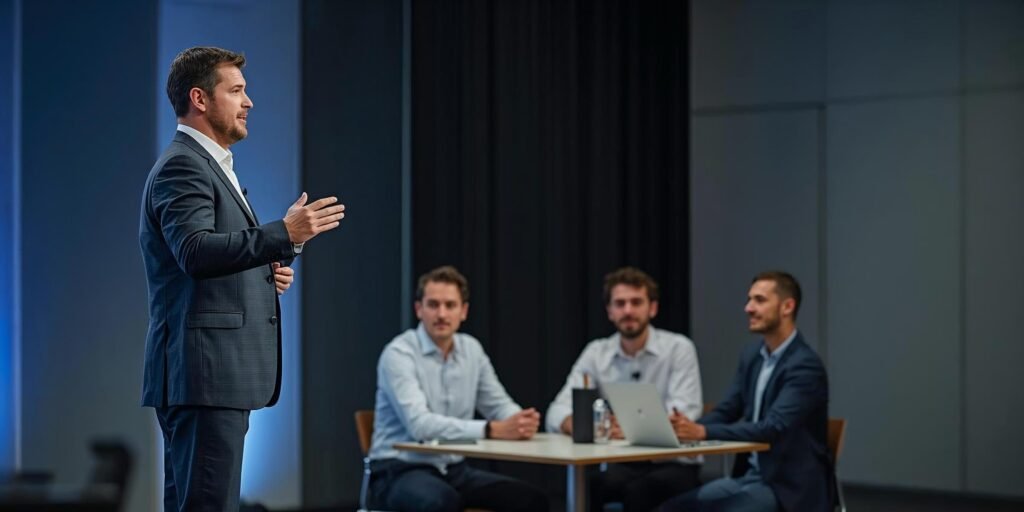
The most successful speakers eventually hit a growth ceiling — not because demand slows, but because the speaker becomes the bottleneck. There are only so many inquiries you can respond to, contracts you can negotiate, and logistics you can juggle while still delivering an exceptional keynote.
Growth requires leveraging talent beyond your own. A small, strategic team helps you stay focused on what only you can do: crafting your message and inspiring audiences.
Here’s how to scale your speaking business by building the right support system — efficiently, sustainably, and with confidence.
🎯 Why Build a Team? Because Your Time Has Value
Ask yourself:
- How many hours do admin tasks steal each week?
- What strategic work is getting delayed?
- What opportunities are you too busy to pursue?
Every hour spent scheduling or invoicing is an hour you aren’t
- writing new content,
- rehearsing,
- or nurturing high-value relationships.
Hiring help doesn’t cost productivity —
it unlocks profit.
🧩 The 4 Core Roles for a Scaled Speaking Business
Not every speaker needs every role immediately. But as your career expands, these positions become essential.
✅ 1️⃣ Executive or Virtual Assistant (EA/VA)
Handles:
- Inbox and calendar control
- Client communication and onboarding
- Travel coordination
- CRM and task management
- Slide version control and event prep
Impact:
- Reduced stress
- Faster response times
- Better client experience
This is usually the first and highest-ROI hire.
✅ 2️⃣ Booking/Business Manager or Agent
Handles:
- Negotiating fees and contract terms
- Lead follow-up and pipeline management
- Qualification of inquiries
- Coordination with event planners
Impact:
- More bookings
- Higher fees
- Better pipeline stability
You focus on performance. They focus on revenue.
✅ 3️⃣ Marketing Support
Could be:
- Content manager
- Social media coordinator
- Branding designer
- Video editor
Impact:
- Increased visibility
- Stronger referral flywheel
- Consistency in messaging
Your ideas deserve distribution.
✅ 4️⃣ Subject-Matter or Research Assistant
Supports:
- Data fact-checking
- Framework development
- Academic sourcing
- New intellectual property creation
Impact:
- Thought leadership stays fresh
- Presentations stay credible
This is your hidden advantage when scaling into books, courses, and consulting.
🚦 When Is It Time to Hire?
You’re ready if:
- You’re turning down opportunities due to capacity
- Admin tasks exceed 30% of your workload
- Your inbox lags beyond 48-hour response times
- Client onboarding feels chaotic or rushed
- You’re not consistently improving your keynote
Growth signals are invitations — don’t ignore them.
💼 Where to Find the Right People
Look for:
- VAs with speaker or event industry experience
- Agents or bureaus familiar with your niche
- Freelancers specializing in thought leadership brands
Referrals from fellow speakers are often the best path.
Culture fit over convenience every time.
🧠 Delegate by Impact, Not Comfort
Most speakers outsource what they dislike doing.
Elite speakers outsource what is not strategic.
Ask:
“Is this task building my brand or revenue?”
If no → delegate.
If yes → retain.
Your highest value activities:
- Speaking & performance
- Product creation & content development
- High-level partnerships
Focus where your genius lives.
📈 Build Systems Before You Scale
Team success depends on clarity:
- Standard operating procedures (SOPs)
- Email templates and scripts
- CRM organization and tagging rules
- Documented onboarding process
Systems empower support —
support empowers your growth.
🤝 Communication: The Secret to Long-Term Collaboration
Check-in rhythms to consider:
- Weekly operations call
- Monthly marketing meeting
- Quarterly strategy session
Clear expectations prevent burnout and guesswork.
Good communication makes small teams feel big.
💡 Compensation and Incentives
Common models:
- Retainer for consistent support
- Commission for booking managers
- Project-based for marketing creatives
Incentive best practices:
- Reward outcomes (bookings, brand lift)
- Celebrate referrals
- Provide growth opportunities
Shared success = sustained loyalty.
📊 Track What Matters: KPIs for Scale
Measure:
- Booking conversion rate
- Average fee growth
- Response times
- Content reach and engagement
- Events leading to additional business
If your team isn’t improving these metrics, adjust roles or processes.
🚫 Pitfalls to Avoid
Be cautious of:
- Hiring without clarity of responsibilities
- Expecting one person to “do everything”
- Micromanaging (trust the experts you hire)
- Delaying delegation out of fear or perfectionism
You can’t scale what you won’t let go.
✅ Your Scaled Team Structure: A Sample Model
| Stage of Growth | Team Structure |
| Emerging Speaker | VA (part-time) |
| Busy Speaker | VA + Marketing support |
| Scaling to Thought Leader | VA + Agent + Marketing team |
| Multi-Product Authority Brand | All above + Research support |
Your team evolves with your mission.
🎯 Final Thought
Scaling isn’t about more work —
it’s about more impact.
When you build a small team with:
- competence,
- clarity,
- collaboration,
you free yourself to:
- craft better message mastery,
- elevate performance quality,
- deliver deeper transformation,
- and enjoy more of the journey.
Your voice is the spark.
Your team keeps the flame burning bright.
Let others help you carry the mission —
because your impact was never meant to be a solo act.
Sources
- https://pmc.ncbi.nlm.nih.gov/articles/PMC3986888/
- https://pmc.ncbi.nlm.nih.gov/articles/PMC4246028/
- https://pmc.ncbi.nlm.nih.gov/articles/PMC3824747/
- https://pmc.ncbi.nlm.nih.gov/articles/PMC8611531/
- https://www.sciencedirect.com/science/article/pii/S1877042815011400
- https://www.sciencedirect.com/science/article/pii/S0742051X21000735