


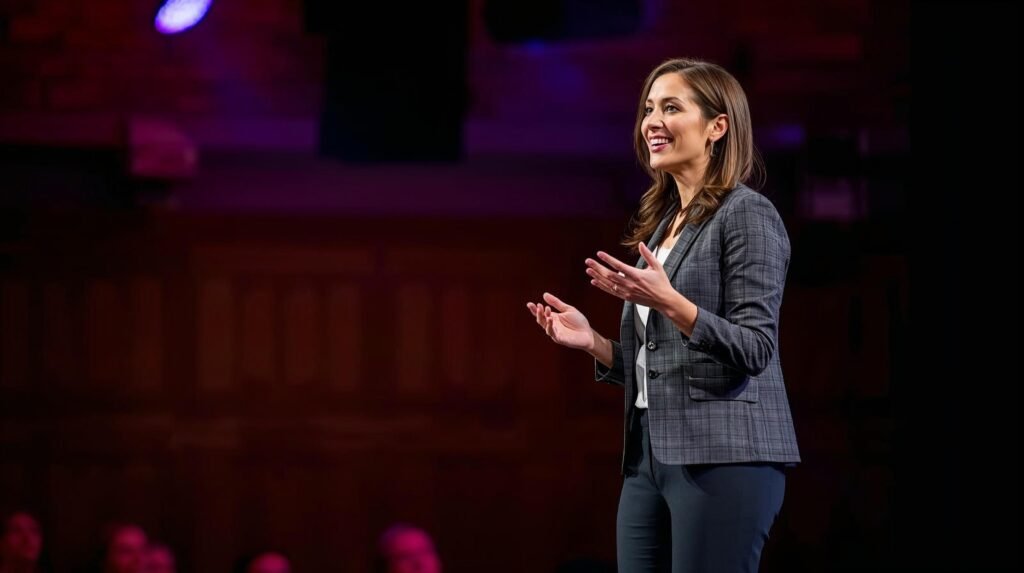
In the speaking industry, your signature message is your brand’s heartbeat. It is the reason event planners return, audiences quote you, and reputation spreads long after you’ve left the stage. But there’s a delicate balance to strike: a signature message must be repeatable, yet never feel rehearsed. It must be polished, but never robotic. It must land consistently, while sounding fresh every time.
The world’s top speakers don’t rely on dozens of topics—they refine one transformative idea until it becomes unmistakably theirs.
This article will guide you through crafting a signature message that flows naturally, feels personal, and scales across stages and audiences.
✅ What Is a Signature Message Exactly?
Your signature message is the central insight you want to be known for. It expresses your unique perspective in one sentence—something clear enough to remember and broad enough to apply widely.
A great signature message is:
- Recognizable: People can describe it even without you present
- Scalable: Works for keynotes, workshops, short talks, and interviews
- Rooted in your lived experience
- Relevant to universal human needs
If someone books you, it’s because they want that message delivered in your voice.
🌱 Start With the Core Insight
Your signature idea should be something you’ve lived—not just researched.
Ask yourself:
- What truth do I keep returning to in my life or career?
- What unresolved question drives my work?
- What transformation have I experienced firsthand?
- What frustrates me that I want to change in the world?
Your message lives in the overlap between your story and their struggle.
Think:
Personal origin → universal relevance → actionable hope
🧠 Make It Memorable With a Strong Structure
Brains remember patterns, not paragraphs. The most iconic messages often follow a simple structure:
- The Rule of 3
- A contradiction or tension (“It’s not about working harder, but working differently”)
- A metaphor or central analogy
Your signature message becomes easier to recall—and to repeat—when it has rhythm, narrative hooks, and simplicity.
🔁 Repetition Without Repetition
There are two kinds of repetition:
- Repetitive delivery — sounds stale
- Reinforced messaging — sounds confident and clear
The key is message consistency paired with story variety.
Keep the message constant. Rotate:
- Personal stories
- Examples from the audience
- Industry data
- Real-time observations or current events
Your audience feels like they’re hearing it for the first time—even if you’ve said it 100 times.
🎤 Speak From Conversation, Not Memory
Audiences can sense when a message is over-rehearsed. The delivery becomes stiff. Authenticity drops.
Try structuring your talk as:
- Anchored openings and closings (memorized and sharp)
- Flexible middle content guided by a clear outline
- Improvisational moments tied to audience reactions
You’re prepared, not scripted.
❤️ Inject Humanity: Vulnerability Is a Differentiator
Your signature message shouldn’t just be polished—it should be personal.
Elements of humanity that deepen connection:
- Moments of failure and learning
- Emotionally rich memory or turning point
- Humor about your own flaws and misunderstandings
Humility and transparency build trust. A message earned is stronger than a message declared.
🌍 Make It Not About You
Your story is the path, not the hero. The audience is the hero.
Shift perspective:
- “Here’s what happened to me” → “Here’s what you can take from this”
- “This is my philosophy” → “This is how your life changes”
Your message becomes their tool, not your trophy.
🎯 Clarify the Actionable Takeaway
A signature message becomes powerful when people can use it.
Every keynote should end with questions like:
- What does this mean for each listener’s next step?
- How does this insight show up in everyday decisions?
- What is the simplest action they can take today?
Purpose + practicality = transformation.
🗣️ Craft a Catchphrase Without Being Cliché
Short, sticky lines help your message travel.
Think:
- A mantra that reinforces the takeaway
- A phrase event-goers will repeat
- A line that fits on social media or a T-shirt
But avoid generic motivational fluff.
Your phrase should point directly to your idea’s specific promise.
🔍 Test Your Message With Real Audiences
Before your message becomes signature, it must survive the real world.
Evaluate:
- Do people quote it back to you?
- Does it spread through conversation?
- Do event planners reference it when reaching out?
- Does the audience use your language after the talk?
If it sticks, you’ve found resonance. If not, refine and test again.
Impact validates clarity.
🔄 Evolve the Message While Keeping Its Heart
The best signature messages:
- Adapt with time
- Respond to social and market shifts
- Grow as the speaker does
Update stories, freshen visual examples, upgrade your language.
The audience should sense that your message is alive—not trapped in last year’s script.
🧩 Final Framework: The Signature Message Blueprint
| Component | Purpose |
| One core insight | The idea you’re known for |
| Emotional origin story | Credibility through experience |
| Repeatable phrasing | Spreadability and brand recognition |
| Actionable takeaway | Real-world transformation |
| Flexible supporting stories | Freshness every time |
When these elements are aligned, you become unforgettable.
Final Thought
Your signature message isn’t something you invent—it’s something you uncover. It’s the throughline of your work, the wisdom your life has earned, and the contribution you want to scale.
When that message feels effortless to share, it becomes effortless to remember.
And when people remember your message, they remember you.
That’s the power of a brand built from the truth you live.
Sources
- https://pmc.ncbi.nlm.nih.gov/articles/PMC3824747/
- https://pmc.ncbi.nlm.nih.gov/articles/PMC3986888/
- https://pmc.ncbi.nlm.nih.gov/articles/PMC4246028/
- https://pmc.ncbi.nlm.nih.gov/articles/PMC8611531/
- https://www.sciencedirect.com/science/article/pii/S1877042815011400
- https://www.sciencedirect.com/science/article/pii/S0742051X21000735